HexTexPartnership

Quantum Collective Scientific Series

How a certified, cleanroom-grade hexagonal nano-graphene matrix should outperform the original study fabric.

A mechanistic synopsis

The Lu et al. 2022 study used a first-generation graphene-loaded textile to demonstrate that a wearable far-infrared emitter could measurably modulate alpha and theta brainwaves. It was a proof-of-concept built for a research publication, not for clinical-grade reproducibility. The result that emerged from a non-optimized prototype is itself the most compelling argument for what a properly engineered, certified, US-manufactured second-generation system can achieve.

The HexTex fabric improves on the Lu prototype across mechanistically independent axes. Each axis, on its own, would predict stronger biological effects. Together, they predict a difference in kind, not just degree — and unlike the Lu prototype, every claim here is backed by independent third-party testing under recognized industrial standards.

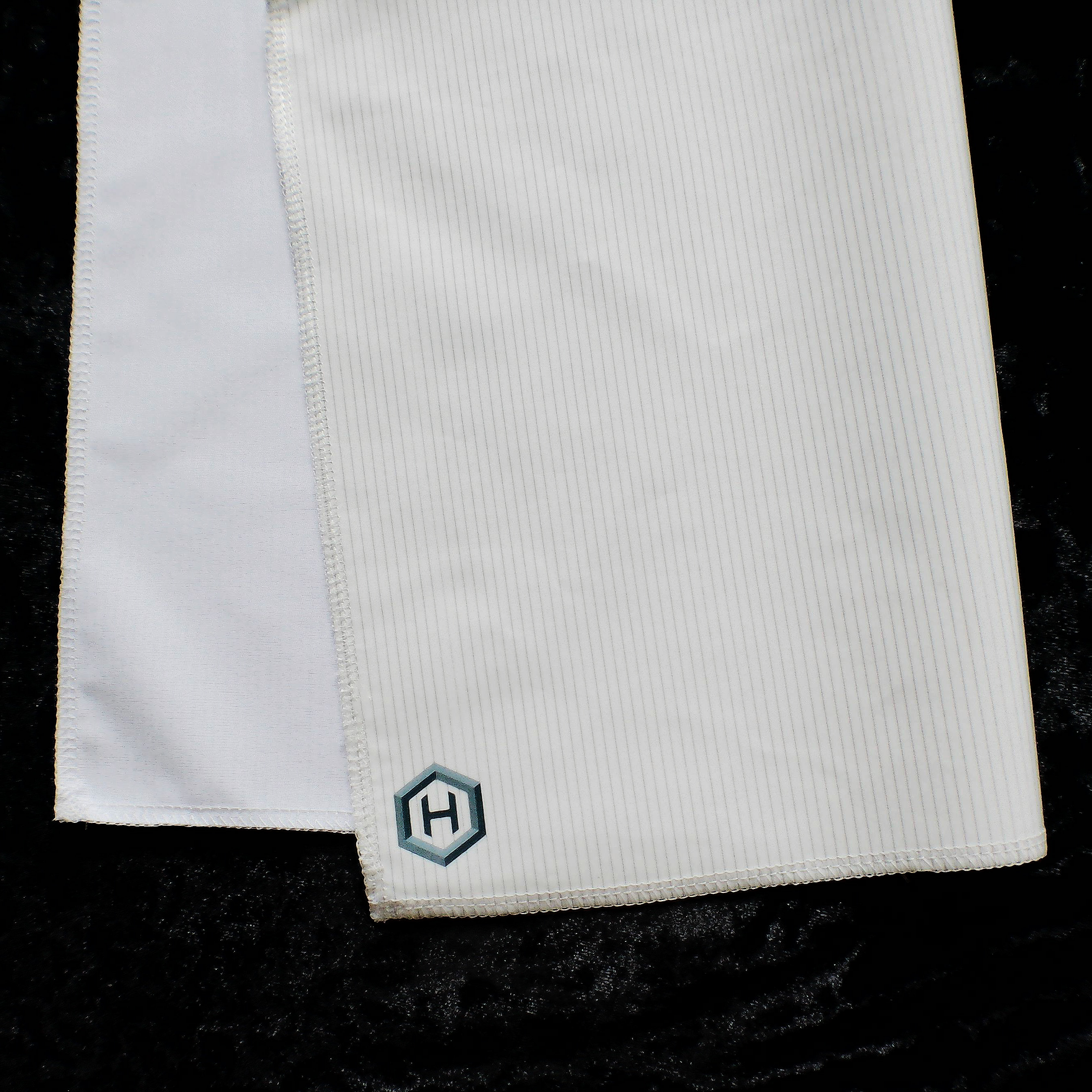
Actual HexTex fabric showing the smooth cotton face beside the fine pinstripe graphene side with the hexagonal H logo
Both faces — cotton and the ~3mm pinstripe graphene lattice
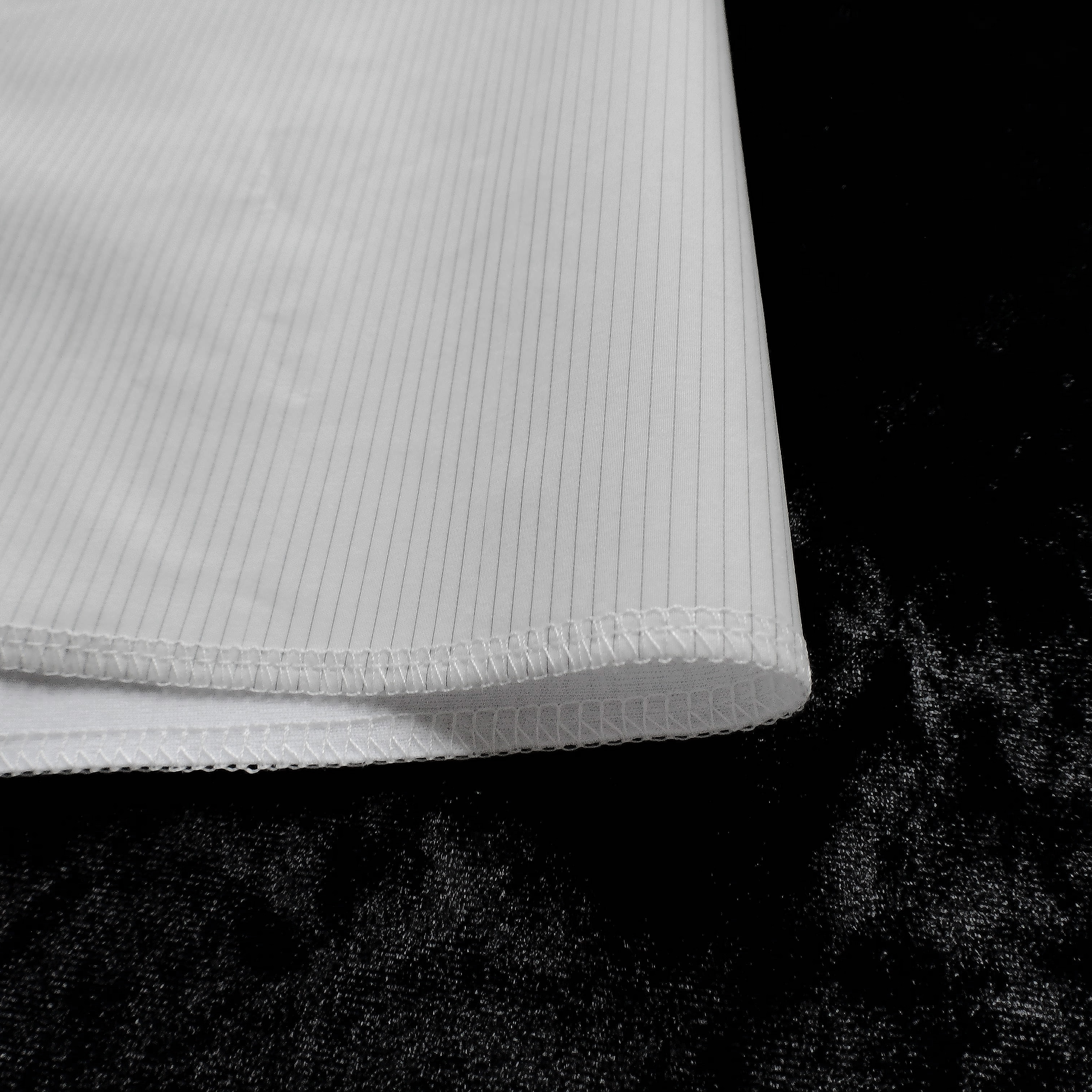
Close-up of the HexTex pinstripe weave and its clean serged medical-grade hem
Uniform stripe geometry and finished, sealed edges
01

Tighter hexagonal lattice geometry

3mm vs. 4mm stripe spacing — a 33% increase in linear emitter density.

Direct measurement against the comparable carbon-stripe reference fabric shows the HexTex textile delivers conductive carbon stripes at approximately 3mm spacing versus the standard 4mm. That is meaningfully more emission lines per square centimeter of skin contact. For water-resonant absorption in the 7–14 µm band, field density at the tissue interface is one of the dominant variables determining biological effect. The Lu prototype was a research weave with no published spacing optimization; the HexTex fabric is a manufactured product with a measurably tighter, more uniform conductive geometry.

02

Cleanroom-grade lattice purity

ISO Class 4 cleanroom compatible — the certification doing the heaviest mechanistic work.

ISO Class 4 cleanroom compatibility means the fabric is manufactured and qualified for environments permitting fewer than 10,000 particles per cubic meter at 0.1 µm — among the most stringent contamination standards in modern industrial manufacturing, used in semiconductor fabrication and pharmaceutical isolation. From a far-infrared emission standpoint, every particulate contaminant, every fiber inclusion, every contaminant atom in the carbon lattice is a defect that radiates off-spectrum or fails to radiate at all. Cleanroom-grade fabrication produces a graphene/carbon matrix with substantially lower defect density than conventionally manufactured alternatives — meaning higher emission efficiency in the target band, more uniform field generation, and batch-to-batch reproducibility that imported alternatives simply cannot match. The Lu fabric was not cleanroom-fabricated; the HexTex is.

03

Validated electrostatic dissipation

Surface resistivity 10^6 to 10^8 ohms/sq; 0.01-second static decay in both warp and fill, FTM-4046 tested.

This is meaningful for two reasons. First, it demonstrates that the carbon stripe is electrically continuous and uniform across the fabric — a non-uniform conductive structure would show inconsistent decay times, and a poorly bonded structure would show drift across orientations. Identical 0.01-second decay in both warp and fill directions is direct evidence of geometric integrity in the conductive matrix. Second, controlled surface resistivity at this range supports the interfacial water dynamics central to the FIR mechanism: when the wearer’s skin contacts a fabric with engineered electrostatic properties, the local electrochemical gradient at the skin-fabric interface differs measurably from contact with conventional textiles — one of the proposed bridges between the FIR field and downstream membrane and autonomic effects.

04

Medical-grade barrier and sterilization stability

AAMI Level 3 compliant under ANSI/AAMI PB 70:2022; gamma-sterilization compatible.

The fabric meets the same barrier classification used for surgical gowns in moderate-fluid-exposure medical procedures, and it is compatible with gamma sterilization cycles. For a wellness textile, these are not directly relevant clinical claims — but they are important quality signals: the fabric is structurally stable, dimensionally consistent under sterilization stress, and built to withstand environments where defective construction would be immediately disqualifying. A fabric engineered to AAMI Level 3 and gamma-stable specifications has a manufacturing tolerance profile that consumer-grade graphene textiles cannot match. The brain doesn’t care whether a fabric is medical-grade — but the brain does respond to the consistency and quality of the FIR field, and medical-grade manufacturing is what produces a consistent field.

05

Independently validated physical specifications

Every claim anchored to ASTM and AATCC test standards — externally verifiable.

Fabric width (ASTM-D-3774), weight at 95 g/m² (ASTM-D-3776), construction at 168 warp × 92 fill (ASTM-D-3775), air porosity (ASTM-D-737), hydrostatic resistance ≥70cm (AATCC-127, indicating engineered water-repellency that protects the conductive matrix from moisture-induced degradation), and surface resistivity (AATCC-76). The Lu et al. fabric reported none of this. It was characterized for the publication and never independently validated for reproducibility. The HexTex fabric arrives with a full, externally administered characterization profile — so every specification can be checked against a recognized industrial standard rather than taken on faith.

Independently tested to

ISO Class 4ANSI/AAMI PB 70:2022FTM-4046ASTM-D-3774ASTM-D-3775ASTM-D-3776ASTM-D-737AATCC-127AATCC-76

The Lu fabric proved the principle. A cleanroom-grade, certified, US-manufactured hexagonal carbon matrix is that principle, executed at industrial precision.